
The Gertrude Polk Brown Lecture Series
Lineage: Genealogy and the Power of Connection in Early America
By Karin Wulf
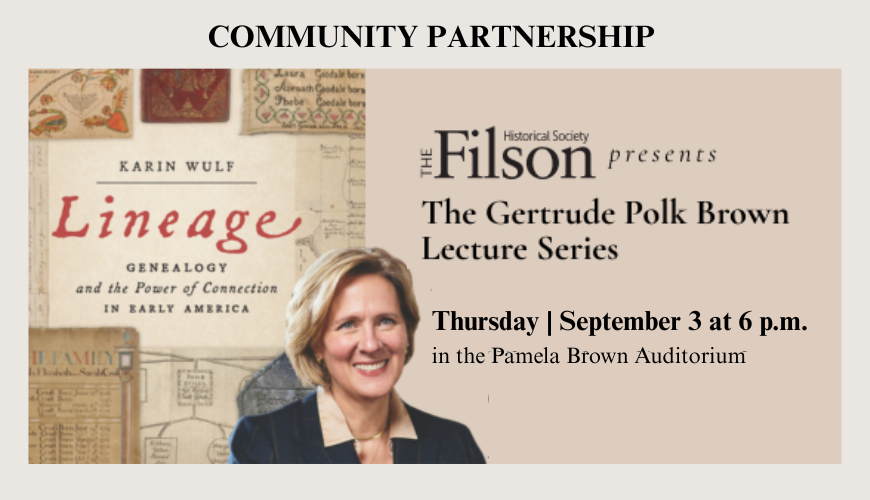
Presented by the Filson Historical Society.
In eighteenth-century America, genealogy was more than a simple record of family ties--it was a powerful force that shaped society. Lineage delves into an era where individuals, families, and institutions meticulously documented their connections. Whether driven by personal passion or mandated by churches, local governments, and courts, these records appeared in diverse forms-from handwritten notes and account books to intricate silk threads and enduring stone carvings.
Family connections wielded significant influence across governmental, legal, religious, cultural, and social spheres. In the American context, these ties also defined the boundaries of slavery and freedom, with a child's status often determined by their mother, despite the prevailing patriarchy. This book reveals the profound importance of genealogy that was chronicled by family records, cultural artifacts, and court documents. These materials, created by both enslaved individuals seeking freedom and founding fathers seeking status, demonstrate the culturally and historically specific nature of genealogical interest.
Even as the American Revolution transformed society, the significance of genealogy endured. The legacy of lineage from the colonial period continued to shape the early United States, underscoring the enduring importance of family connections. Lineage offers a deep understanding of genealogy as a foundational element of American history, illuminating its vital role from the colonial era through the birth of the nation.
Karin Wulf is the Director and Librarian of the John Carter Brown Library and Professor of History at Brown University. The author or editor of prize-winning scholarship on gender, family, and politics, she writes regularly for both public and academic audiences about early American history, the humanities, and archives and libraries.
The Gertrude Polk Brown Lecture Series is presented by the Filson Historical Society, one of Kentucky’s largest privately funded historical societies. Initiated in 1993 as a memorial to the life of Gertrude Polk Brown, this series is made possible by the continuous generous support of her daughter, Dace Brown Stubbs, and her grandchildren, Marshall Farrer and Dace Polk Brown; her daughter, Laura Lee Brown, and her grandchildren, Garvin Deters, Polk Deters and Laura Lee Gastis; and her grandson(s), G. Garvin Brown IV, and Campbell P. Brown. The series has brought internationally recognized historians to Louisville. More than 43,000 citizens have learned more about the significant stories of our region, nation, and world because of the Gertrude Polk Brown lectures.
For more information about the Filson, please visit filsonhistorical.org.

The Gertrude Polk Brown Lecture Series
Presented by the Filson Historical Society.
In eighteenth-century America, genealogy was more than a simple record of family ties--it was a powerful force that shaped society. Lineage delves into an era where individuals, families, and institutions meticulously documented their connections. Whether driven by personal passion or mandated by churches, local governments, and courts, these records appeared in diverse forms-from handwritten notes and account books to intricate silk threads and enduring stone carvings.
Family connections wielded significant influence across governmental, legal, religious, cultural, and social spheres. In the American context, these ties also defined the boundaries of slavery and freedom, with a child's status often determined by their mother, despite the prevailing patriarchy. This book reveals the profound importance of genealogy that was chronicled by family records, cultural artifacts, and court documents. These materials, created by both enslaved individuals seeking freedom and founding fathers seeking status, demonstrate the culturally and historically specific nature of genealogical interest.
Even as the American Revolution transformed society, the significance of genealogy endured. The legacy of lineage from the colonial period continued to shape the early United States, underscoring the enduring importance of family connections. Lineage offers a deep understanding of genealogy as a foundational element of American history, illuminating its vital role from the colonial era through the birth of the nation.
Karin Wulf is the Director and Librarian of the John Carter Brown Library and Professor of History at Brown University. The author or editor of prize-winning scholarship on gender, family, and politics, she writes regularly for both public and academic audiences about early American history, the humanities, and archives and libraries.
The Gertrude Polk Brown Lecture Series is presented by the Filson Historical Society, one of Kentucky’s largest privately funded historical societies. Initiated in 1993 as a memorial to the life of Gertrude Polk Brown, this series is made possible by the continuous generous support of her daughter, Dace Brown Stubbs, and her grandchildren, Marshall Farrer and Dace Polk Brown; her daughter, Laura Lee Brown, and her grandchildren, Garvin Deters, Polk Deters and Laura Lee Gastis; and her grandson(s), G. Garvin Brown IV, and Campbell P. Brown. The series has brought internationally recognized historians to Louisville. More than 43,000 citizens have learned more about the significant stories of our region, nation, and world because of the Gertrude Polk Brown lectures.
For more information about the Filson, please visit filsonhistorical.org.
Lineage: Genealogy and the Power of Connection in Early America
By Karin Wulf

Dates and Tickets
Meet the Artists



If you or someone you know is experiencing domestic violence, or if you want to learn more about this issue, check out these RESOURCES. For immediate assistance, call the 24-hour National Domestic Violence Hotline at 1-800-799-7233.
If you or someone you know is thinking about self-harm or suicide, check out these RESOURCES. For immediate assistance, call the 24-hour National Suicide Prevention Lifeline at 1-800-273- 8255.\

Our Resources


If you or someone you know is in crisis or thinking about self-harm or suicide, there is help available.
If you require immediate assistance:
Call 911
Go to the nearest emergency room
Call the toll-free, 24/7 National Suicide Prevention Lifeline at 1-800-273- TALK (8255)
Text TALK to 741-741 to text with a trainee crisis counselor for free, 24/7
Si tú o alguien que conoces tiene pensamientos suicidas, una línea directa de prevención puede ayudar. La Línea Nacional de Prevención del Suicidio está disponible las 24 horas del día llamando al 800-273-8255, en inglés y español. Los recursos debajo que ofrecen soporte en español están marcados.
Hear From Our Members


your performance by joining a membership!